Tuesday, August 30, 2011

JR (French) – street artist


The Parisian photographer JR is a man routinely touted as the hippest street artist since Banksy. His work has sold at Sotheby's and been plastered 100ft high on the wall of Tate Modern. His celebrity admirers include Trudie Styler and Damon Albarn. But regardless of his undoubted artistic pedigree, it seems inevitable, given his name, to ask him about Dallas.

So is his two-letter moniker a tribute to the fictional 80s oil baron JR Ewing?

"No," he laughs when we meet in his Paris studio, a bright, airy space filled with video-game consoles and designer chairs. "It's just my initials."

And they stand for?

"I can't say."

The deliberately enigmatic reply is more than mere artistic pretension. In fact, JR's anonymity is crucial to the integrity of his work: this is an artist who prides himself on operating under the radar, on creating dazzling installations in unexpected places through the force of his personality and vision.

As a teenager, he started out as a graffiti artist but began taking photographs when he found a camera on the Paris Métro. Now aged 26, he mixes the two forms and styles himself a "photograffeur", pasting oversize black-and-white photographic canvases in surprising public locations. It is something of a point of honour never to ask permission from the authorities.

"The fact that I stay anonymous means I can exhibit wherever I want," he explains with a broad grin, a plate of microwaved lamb tagine balanced precariously on his knees. "No one knows my name, so it's easy for me to travel."

In the aftermath of the 2004 riots in the Parisian suburbs, JR chose to exhibit in the grand central districts of his home town, pasting up photographs on the walls of the Marais. Portrait of a Generation featured close-up pictures of the young residents of the banlieues pulling funny faces through a fish-eye lens. Instead of the immigrant thugs of popular imagination, the Parisians who walked past JR's photographs were confronted with a more human image. "Most of the media shots of the rioters were taken with a long lens," explains JR, who comes from a mixed-race background with Tunisian and Eastern European heritage. "I used a 28mm lens to capture them really close up."

The second phase of his 28 Millimètres project took JR to the Middle East, where he mounted what is believed to be the largest illegal photo exhibition in the world. Appropriating a border wall running the length of the disputed areas between Israel and Palestine, JR pasted a giant triptych of a rabbi, a priest and an imam wearing deliberately comic expressions. The message was simple but arresting: when you are mugging it up for the camera, what brings you together is more in evidence than what sets you apart. "It's about breaking down barriers," JR says. "With humour, there is life."

Most recently, JR's ad-hoc exhibition space has included some of the most dangerous and poverty-stricken places in the world. Women Are Heroes is the third phase of the project and has seen him travelling to the slums of Kibera, Kenya, where he covered 2,000m² of rooftops with blown-up photographs of the women who lived there.

"I was interested in women because I realised in the projects I'd done before – most of the time in the kind of places I was going to – it was men on the street, but it's actually the women who are the ones holding the community together."

Then in 2008 he went to Morro da Providencia, the oldest and most perilous favela in Rio de Janeiro, to paste portraits of its female residents on the sides of the houses in which they lived. The distinctively monochrome eyes and faces were positioned looking towards the centre of Rio, a constant reminder of the grinding poverty that exists on the doorstep of one of the most cosmopolitan cities in the world.

"I asked each woman to give me something real," says JR, recalling the process. And it is true that, in contrast to the usual media images of grief and despair, the women project a pride in where they come from and a certainty about their own identity. "The photo is the story," he says. "They all gave me really strong eyes because they knew they would be facing the city."

It seems difficult to imagine JR in the heart of a drug-ridden favela. He is a slim and smiley young man, today wearing the casual uniform of the urban hipster: a Day-Glo sweatshirt, a black trilby and a pair of fashionable, thick-rimmed glasses. Was he scared? "Yeah of course," he says, nodding his head vigorously. "You can't even get a taxi to take you there… There are kids with guns and bulletproof jackets on the street. It's like finding yourself in the middle of a war."

In fact, the favela is so lawless that journalists are banned and no NGO operates there. Undeterred, JR simply drove himself to the centre of the shanty town and started chatting about what he wanted to do to anyone who approached him. He had been drawn to the favela by news reports concerning the murder of three innocent young men caught up in the brutal turf wars between drug traffickers and corrupt military police.

"Everything is about eye contact," JR says. "The first thing they have to know is that there's no brand behind it, that's really important… I'm not trying to use the favela to advertise Red Bull or BMX bikes, and I'm not a journalist either.

"I could speak for hours about the origins of the poster technique, but out there, there is not the same frame of reference. You have to go straight to the point. There's this person in front of you and there's no fucking around. That's how I test my projects: if they get it, it's going to work."

Almost immediately, the women of the favela understood what JR was trying to do. He asked anyone interested in participating to come along to an informal meeting. "The women who came were the ones related to the three kids who had been killed: the grandmother, the mother, the best friend. They reappropriated my project to tell their story." The end result was startlingly beautiful: a faceless community with its humanity regained.

But however successfully JR's installations work as art, they have a social conscience, too. In Kibera the photographs of women on the rooftops were printed on to vinyl so that their homes would be waterproof. The sheets of corrugated iron used in another part of the shanty town were distributed afterwards to those who had taken part. Last April JR returned to Rio to set up a cultural centre in the heart of the favela. All of the money he makes from the sale of his work – in 2009 a print of one of JR's most famous photos, "Ladj Ly", sold at auction for £26,250, and he has just sold an image to Damon Albarn for the cover of the forthcoming Africa Express album – is ploughed back into his projects so that JR can ensure his continued independence. "The finance is a key part," he says. "You wouldn't take it in the same way if I did it with L'Oréal."

There is a sense, also, that if JR were to reveal his name or speak more about his background, this would somehow detract from his work. Most graffiti artists start out by tagging their name on empty walls and tube carriages. JR does something different: he takes those who live on the margins of mainstream society and he gives them back their individuality. Paradoxically, perhaps, the photographer without a name creates extraordinary art by restoring the identities of the nameless.


by Elizabeth Day
The Observer, Sunday 7 March 2010
from: http://www.guardian.co.uk/artanddesign/2010/mar/07/street-art-jr-photography

More debate on the changing context of street art

ANOTHER GOOD WEBSITE ON THE DEBATE


Vik Muniz (Brazilian) - social message focussing on raising awareness of different social groups

Finding beauty in a world of waste
Artist Vik Muniz explores the visible and the hidden in an unusual mix of materials
By DONALD EUBANK
Staff writer
"If we live in a creative universe, we are constantly pushing the chaos out of the way to protect ourselves from the nonlogical — the natural," muses Vik Muniz at an interview late last year at Tokyo Wonder Site. "Even when you think, you create waste. But everything is made in a way to conceal the waste.
The New York-based artist isn't afraid to step into that chaos. One of his latest projects, currently on show at Tokyo Wonder Site's Shibuya galleries, was realized in the biggest garbage dump in the world, Jardim Gramacho, north of Rio de Janeiro.
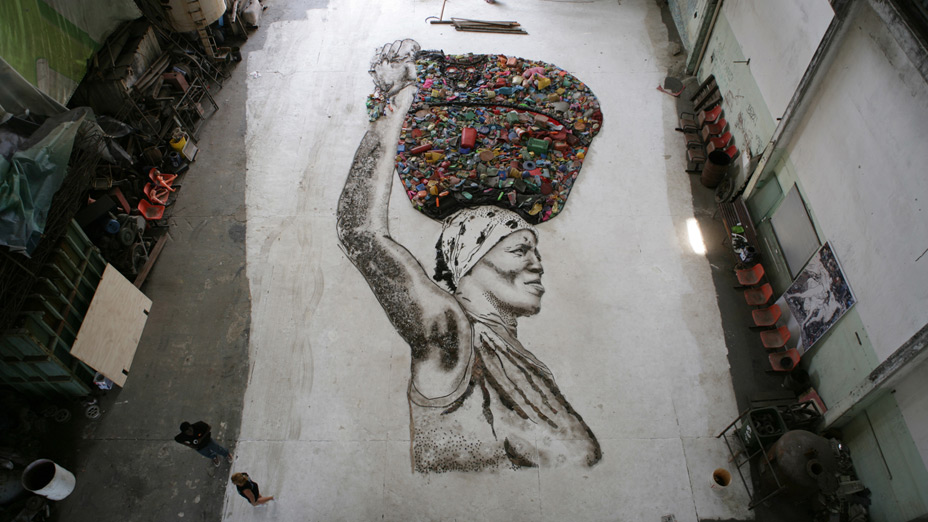
There, he worked with the people who scavenge the recyclable refuse of the city — catadores in Portuguese — to make a living. Muniz, who grew up in Brazil, works in unexpected mediums, taking photographs of drawings he does out of sugar, chocolate, dust. But he had always wanted to do something with trash.
"The beautiful thing about garbage is that it's negative; it's something that you don't use anymore; it's what you don't want to see," says Muniz in a movie made about the project with British documentary director Lucy Walker and Brazilian director Joa~o Jardim (tentatively titled "Extraordinary Garbage" or "The Art of Garbage"). "So, if you are a visual artist, it becomes a very interesting material to work with because it's the most nonvisual of materials. You are working with something that you usually try to hide."
The artist believes that the catadores too are invisible within the class system of Brazil. An estimated 3,000-5,000 people live in the dump, 15,000 derive their income from activities related to it, and some that Muniz met in Jardim Gramacho come from families that had been working there for three generations.
"These people are at the other end of consumer culture," he says. "I was expecting to see people who were beaten and broken, but they were survivors."
His aim — besides the creative challenge — was to see not only if the experience of creating art could change people, but, to answer the question, "can you change people; can this be done?"
Muniz selected a number of the catadores to collaborate with him to make their own portraits, including Irma~, a cook who sells food in the dump; Zumbi, the resident intellectual who has held onto every book he's scavenged; and 18-year-old Suelem, who first arrived there when she was 7. He rented 4 tons of junk and a warehouse, and together they arranged the trash on the ground to replicate photographs of themselves that Muniz had taken earlier. Then they would climb up to the ceiling and take photos of the compositions from 22 meters high.
The portraits of the people are made out of empty spaces, out of what wasn't garbage. Shown themselves in this light, the trash collectors were astonished. Two have since left the dumps; another, Tia~o, is using $64,097 from the project — money Muniz raised in an auction at Phillipe de Pury in London by selling the portrait he did of the politically active young catadore — for the Garbage Pickers Association of Jardim Gramacho.
"Ask them what they need, and they usually say 'nothing.' They live in a very civilized, honest way," observes Muniz. "People at the margins, including artists, we don't have power, but we have freedom."
Excerpt from: The Japan Times: Thursday, Jan. 1, 2009

Goya (Spanish) – war, inequality, class, religion


This image shows the random executions of the Spanish citizenry resulted from the fighting in the Puerto del Sol area of Madrid (Also see the Goya painting Second of May). A national uprising in Spain followed, and scenes such as Goya's 'Third of May' were repeated throughout the Spanish countryside, as the French commanders failed to quell the national mood, and instead made it more furious.
Goya had previously admired the practical freedoms the French "enlightenment" had promised. Most of the Spanish intellectuals of Goya's time were weary of the faltering efforts of Charles IV and Ferdinand to bring reform and improvement to Spain. However, the brutality of Napolean (through his brother Joseph & the military commanders instructed to minimize the fighting there) suspended whatever affection the Spanish liberals had for French freedoms.
For the length of the six-year occupation by the French, Goya lived almost entirely in Madrid. There is much speculation in art books about whether Goya personally witnessed events such as 'The Second of May,' and 'The Third of May." It is evident that Goya owned property at La Quinta, where the massacres took place, and there is (though disputed by some historians) a story by one of Goya's gardeners, a man named Isidro, who told Antonio Trueba (recorded in his book Madrid por fuera) that Goya witnessed the shootings at Montana del Principe Pio via telescope (a telescope was inventoried as belonging to Goya after his death), and that Isidro accompanied Goya later that night to the place where the corpses were, at which time Goya made notes. This account is referenced in Xavier de Salas book GOYA, published 1978 by Mayflower books.
...the Third of May, has become even more famous, haunting the covers of history books, appearing on postage stamps and postcards. It has been used to epitomize the art of Goya, as well as the spirit of Spanish revolutionary heroism. This violent yet moving image depicts the public execution of insurgents on 3 May 1808, the day following the insurrection [see Goya's Second of May] In contrast to the vigour of the street battle, in which the Spaniards appear, momentarily, to be gaining the upper hand, this massacre of civilians, which the French carried out in reprisal for the insurrection, has been painted in the most eye-catching colours. Here, in glowing whites, golds and scarlets against the sombre blacks, greys and browns of the background, the doomed men are immortalized, the street fighters from the Second of May meet their fate. One or two are recognizable: the corpse sprawled below the living victims, a prone male figure with matted blood-soaked hair and shattered skull, is identifiable as the hero with the dagger, stabbing the horse in the right-hand foreground of the proceeding picture.
[Above] from Sarah Symmon's book, Goya
Phiadon Press, 1998. Page 263.
To read about Symmon's book, go here
Also, visit Dr. Symmon's web site here.
Most of the victims have faces. The killers do not. This is one of the most often-noted aspects of the Third of May, and rightly so: with this painting, the modern image of war as anonymous killing is born, and a long tradition of killing as ennobled spectacle comes to its overdue end.
[Above] from Robert Hughes book, Goya,
Knopf Books, 2003. Page 317.
To read about Hughes' book, go here.

Text from:  http://eeweems.com/goya/3rd_of_may.html


Monday, August 29, 2011

Jane Alexander - Politics, racism, apartheid South Africa


The Butcher Boys, 1988-89, plaster

The “Butcher Boys” were created in the context of South Africa’s Apartheid history. The “Butcher Boys” are symbolic of how not speaking out against evil make us become evil. The figures don’t have spines (if you walk around the work you can see there are hollow groves where the spine should be). They don’t stand up for what is right – they are literally spineless. They are detached from what is going on around them – the oppression that took place during apartheid. They don’t have ear (only small holes in their heads). Their eyes are dark and cold. They mouths are shut and have become animal like snouts… because they do not speak out against what is wrong.


The sculptures are frightening to look at and elicit a sense of repulsion in the viewer. It forces the spectator to evaluate the change that took place in society; these forms used to be men but have been transformed into demons. Through this sculpture, Alexander not only portrays the regular use of violence in a masculinized regime but also the way the Apartheid regime changed and brutalized a whole section of society. While its impact on the general viewing public has not been measured, it serves as an addition to the growing archive of visual arts that is spreading in South Africa to confront its past.

Fiona Hall (Australian) – the environment, politics, war

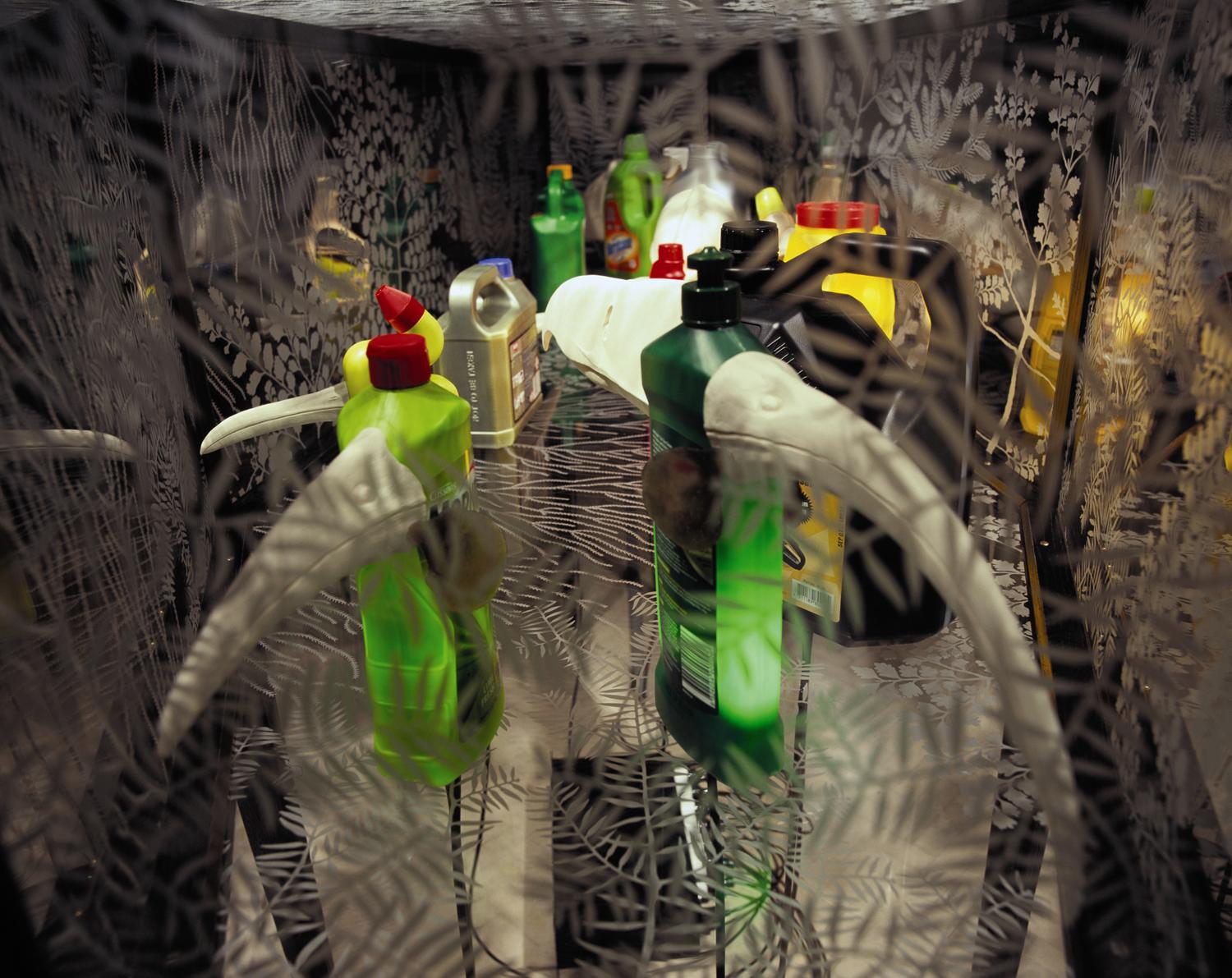
    'Mourning Chorus', 2007 - 08, resin, plastic, vitrine


Curator’s Quote
Fiona Hall’s recent work Mourning Chorus (2007-08) refers to the demise of the once ‘deafening’ song of New Zealand’s bird fauna. This work brings together characteristic aspects of Hall’s practice; flora and fauna are represented by reworked found objects and an ironic reference is made to the museological practice of collecting specimens—species that were once seen in nature are now only seen dead in the museum.

Eleven extinct or endangered bird species are represented by disposable plastic chemical containers animated by carved and cast resin beaks. Bottles of toxic chemicals that eradicate insects, for example ‘Beetle and Grub Killer’ stand as a metaphor for the destruction of bird species and light up
randomly as though flickering to life. All this is visible through the delicate vinyl patterns of native New Zealand plant foliage, spread across the glass panels. The complex circuit of wires below the coffin connects the birds to the earth, as though allowing the toxic liquid to drain into the ground, causing further destruction.

Mourning Chorus is a work born out of Hall’s interest in the environment and humanity’s impact on it. During an artist residency in New Zealand in 2006, she began to research the politics of bird extinction. Describing New Zealand “like a silent island”5, Hall recalled reading an entry dated 6 February 1770 from the diary of Joseph Banks, “This morning I was awaked by the singing of the birds ashore... the numbers of them were certainly very great…their voices were certainly the
[most] melodious wild musick I have ever heard, almost imitating small bells but with
the most tuneable silver sound imaginable.” 6

The discrepancy between Banks’ description of New Zealand and her own formed the conceptual framework for this artwork.

Isabel Finch, 2008

Research Information
Many Australian and New Zealand bird and plant species have evolved from a common ancestry, with shared origins from the time when both lands were part of the ancient, southern super continent known as Gondwana. However the subsequent post- Gondwanan development of New Zealand fauna took a very different path: an absence of native mammals and snakes enabled the
continued evolution of unique bird species, many of them flightless and ground-nesting.

Waves of human migration over the past 900 years have disrupted this vulnerable ecosystem.
The introduction of predatory animals such as rats, stoats and weasels has devastated the populations of numerous species. Land-clearance and the arrival of other environmental competitors such as possums and rabbits have hammered more nails into the coffin of the demise of New Zealand’s birds. Of the eleven bird species represented in Mourning Chorus nine are extinct, and two, the Kakapo and the Little Spotted Kiwi, are extinct in their native habitats but undergoing breeding programs on several of New Zealand’s off-shore island sanctuaries which
have been cleared of vermin. A number of the birds and all of the tree species represented in Mourning Chorus are closely related through their Gondwanan ancestry to others native to Australia.

Fiona Hall, 2008

Text from: Fiona Hall Force Field exhibition at the MCA in 2008

Wangechi Mutu (African)- changing culture of African women


  Wangechi Mutu (*1972),
The Bride Who Married a
Camel's Head
, 2009  


Snakes slither out of her Medusa’s head, which is adorned with mushrooms, shells, and pearls. In her hand, she is holding the mouth of a camel opened wide in a scream. With its strange marriages, Wangechi Mutu’s The Bride Who Married a Camel’s Head is typical for the work of the New York-based Kenyan artist: Mutu’s collages combine images from fashion, sports, and sex magazines to create hybrid, “exotic” creatures that are simultaneously human and animal, monster and machine. Mutu, who was Deutsche Bank’s first “Artist of the Year” in 2010, addresses issues of feminine identity in the fraught relationship between western culture and post-colonial history. At the same time, her collages explore the dreams and desires propagated by the global consumerist society and its effects: the ruthless exploitation of natural resources and a world in which the body has become a product.


Text from: http://dbcollection.db.com/en/artworks2010.html