Ben Quilty
Landcruiser, 2007
Cinese Ink and Goauche on Aquari paper
188 x 282cm
It’s an old trick. Take a universal, publicly owned snatch of
melody, fanfare, phrase or image and pervert it. Ben Quilty
has used the Australian coat of arms, an image so offi cial and
hoary it’s almost invisible, and mounted it on a mesa piled
with skulls. The shield-bearers are presented as road-kill,
the kangaroo muzzle fl attened by a double bogie. Between
them now is a cairn of skulls knitted by worms and lies. The
crest is a convict shackle, looking as though it was cut from
a kerosene tin, just to make it clear that not all the bones
belonged to Indigenous Australians.
Like most people, Ben Quilty defi es caricature. A bogan who
chose to pursue a degree in Aboriginal culture. A petrolhead
who buys his art supplies at Bunnings, yet carries tiny
notebooks full of the most exquisite pen-and-ink sketches of
Venice done in his recent youth. Close in, where Quilty works,
his paintings look like a bad paving job. Step back twenty
feet and he’s caught the whole sorry tale, a country built by
the survivors of pogroms, massacres and land clearances
elsewhere, who found a haven here on land cleared by
massacres of our own.
Don Walker
Text from: UQ Art Museum http://www.uq.edu.au/maynecentre/docs/BenQuiltyInterpretiveGuide.pdf
When people ask him why he paints such pessimistic work, Quilty says his view of Australians preferring to ignore the less-than-rosy aspects of Australian history is confirmed. "I love my life, my family, friends and work, and I'm a very lucky person," he says. "But there are some really bad things happening. It seems to me that in Australia no one talks about them, and if you do you're branded as a pessimist. It's just ridiculous.
"The whole 'un-Australian' thing at the moment, that's just insane. I mean, Captain Cook shot the first Aboriginal he met - well, let's talk about that. What's un-Australian? What school do you ever learn Aboriginal in? You learn French and German but I've never heard of a school that teaches Aboriginal and that's the most un-Australian thing I can think of."
Quilty also finds it bizarre that the Union Jack, rather than a representation of Aboriginal people, remains on the Australian flag. "I'm happy to burn the flag. As long as it's got the Union Jack on it, I'll burn it. The Australian flag, as it is, speaks to me of oppression and invasion and it's so politically incorrect to say any of this stuff, but it's also so obvious."
Text from:
http://www.smh.com.au/news/arts/the-hot-seat-ben-quilty/2007/03/16/1173722723863.html
Rorschach – the
Butterfly Effect, 2008.
Where did all this darkness come from? "I started using the skull image when I was buying kids' clothes for my cousins," Quilty, 34, says. "Everything for boys had skulls emblazoned on it. And I just thought, it's such a weird thing to be instilling in little boys, who are full of life."
Showing posts with label male artists. Show all posts
Tuesday, September 6, 2011
Friday, September 2, 2011
Hayden Fowler (Australian) - politics
For Hayden Fowler, one motivation for his art practice is a critique of contemporary Western society. Fowler investigates our interactions with the natural world and how we define ourselves with regard to nature. He is interested in the nexus between civilisation and the domestication of animals, focusing on aspects such as interdependency and adaptation.
In the video White Australia, white rats scuttle through two holes in a similarly tiled interior space. Talking about the work, Fowler describes it as his response to what he saw as the dangerously apathetic nature of dominant Australian culture during ‘the height of the Howard years’. Inspired by the unthinking mass movements of 9-5 commuters at a busy train station, the artist presents his rats as creatures caught in a system of power they have little control over. (1)
Highlighting the disquieting possibilities of our own increasingly narcissistic preoccupations, Fowler’s work suggests the need for a necessary empathetic relationship between humankind and animals.
Text from: the MCA website - http://collection.mca.com.au/fowler-hayden/white-australia/
Labels:
Cultural Framework,
male artists,
politics
Wednesday, August 31, 2011
Blu - street artist - political take on big global corporations
CONTROVERSIAL STREET ART
Blu, a secretive Italian, is famous for his amazing murals and graffiti the world over.
His distinctive comic book style sometimes deliver caustic messages against big corporations like the oil companies. One of his controversial street art creations is the smoking politicians mural, which was intended as a protest against political inaction towards pollution in Southern Italy.
Text from: http://www.trendhunter.com/trends/controversial-street-artHis distinctive comic book style sometimes deliver caustic messages against big corporations like the oil companies. One of his controversial street art creations is the smoking politicians mural, which was intended as a protest against political inaction towards pollution in Southern Italy.
Labels:
Cultural Framework,
male artists,
street art
Do-Ho Suh (Korean) – war, identity
Looking at Some/One
An artist who has explored war through his art is Do-Ho Suh. In his piece "Some/One," constructs a sculpture made up of thousands of dog tags, which are circulated through every soldier in the U.S. and beyond. Observers first identify a fish scaled garment, made from thirty thousand dog tags, which is too resemble a soldiers garment. Suh's sculpture conveys the dehumanization of a soldiers role in society, but how can viewers put his piece into context, and understand it by connecting to their own experiences in order to relate it to their own knowledge and understanding? What do dog tags mean generally in art and to the artist himself? Suh''s interpretation is more than literal.
Before any other research was conducted I could not connect this piece to any of my own experiences. The only knowledge I could connect the piece with was war and a community of soldiers somehow formed into a rope.
An article from the online journal base called "Home in The World: The Art of Do-Ho Suh" was helpful to some questions posed before determining the guiding question. Suh's works have a lot to do with experiencing space and identity. In "Some/One," the sculptures back is turned to entering viewers. Viewers are invited to walk around the piece and soon stand face to face with themselves, when they discover that the garment has an opening that is line with mirrored foil. Like in Suh's other works viewers have to walk over the bridge, across the floor, or under seoul home. They all have double meaning concerning the construct of identity. This identity focuses on the importance of the individual as a single representative of a greater entity, such as a nation. Instead of being viewed as multiple individuals, viewers see the greater body.
In "Some/One," the gallery floor in New York City is covered with a blanket of shiny military dogs tags, bringing to mind, all the shadowed identities. Each single soldier is part of a larger military body, deprived from individual human qualities. A quote by Sollins about dehumanization of soldiers in Suh's work is present in how the dog tags used,
"swell to form a hollow, ghost like suit of armor at the center of the room. Whether addressing the dynamic of personal space verses public space, or exploring the fine line between strength in numbers and homogeneity, Do-Ho Suh's sculptures continually question the identity of the individual in todays increasingly transnational, global society," (Sollins).
The piece draws attention in a way which viewers are welcome to occupy and inhabit the space. As they walk over the piece and face the front of it they are able to see the inside of the piece, which has mirrors embodied inside the stainless steal garment. That moment is symbolic because the viewer is experiencing the piece physically by stepping on the dogs tags, and also when they see their reflection inside the front of the garment.
Before any other research was conducted I could not connect this piece to any of my own experiences. The only knowledge I could connect the piece with was war and a community of soldiers somehow formed into a rope.
An article from the online journal base called "Home in The World: The Art of Do-Ho Suh" was helpful to some questions posed before determining the guiding question. Suh's works have a lot to do with experiencing space and identity. In "Some/One," the sculptures back is turned to entering viewers. Viewers are invited to walk around the piece and soon stand face to face with themselves, when they discover that the garment has an opening that is line with mirrored foil. Like in Suh's other works viewers have to walk over the bridge, across the floor, or under seoul home. They all have double meaning concerning the construct of identity. This identity focuses on the importance of the individual as a single representative of a greater entity, such as a nation. Instead of being viewed as multiple individuals, viewers see the greater body.
In "Some/One," the gallery floor in New York City is covered with a blanket of shiny military dogs tags, bringing to mind, all the shadowed identities. Each single soldier is part of a larger military body, deprived from individual human qualities. A quote by Sollins about dehumanization of soldiers in Suh's work is present in how the dog tags used,
"swell to form a hollow, ghost like suit of armor at the center of the room. Whether addressing the dynamic of personal space verses public space, or exploring the fine line between strength in numbers and homogeneity, Do-Ho Suh's sculptures continually question the identity of the individual in todays increasingly transnational, global society," (Sollins).
The piece draws attention in a way which viewers are welcome to occupy and inhabit the space. As they walk over the piece and face the front of it they are able to see the inside of the piece, which has mirrors embodied inside the stainless steal garment. That moment is symbolic because the viewer is experiencing the piece physically by stepping on the dogs tags, and also when they see their reflection inside the front of the garment.
Picasso (Spanish) - war
An Introduction to Guernica
On April 26 1937, late in the afternoon, the undefended Basque town of Guernica was bombed relentlessly for three hours by German and Italian aircraft that were acting on the instructions of Franco's Nationalist forces. The horrific campaign experimented with the potency of modern warfare, including incendiary bombs, explosives and shrapnel and was deliberately aimed at destruction of the civilian population. Escort planes that plunged from the sky to strafe people fleeing from the town exacerbated the massacre. The town was razed to the ground. Of the ten thousand inhabitants and refugees who made up the population of Guernica, three thousand were estimated to have died and thousands more were injured and mutilated.
When newspaper reports of the brutal attack appeared the following day the world was shocked and outraged, particularly as the attack took place on market day. Also, most of the inhabitants of Guernica were women, children and the elderly, because the younger men were away fighting in the Republican army.
To access Bombing of Guernica: original Times report from 1937:
Picasso had never been moved to engage in overtly political art, but his deep sorrow at the outbreak of civil war in his homeland (where his cousins were fighting on the Republican side), and his relationship with the politically charged Dora Maar, a member of the French Communist Party, had galvanized the passionate Spaniard into publicising his outrage. Early in 1937 he began the Dream and Lie of Franco, a series of fourteen etchings designed to be published as individual postcards to raise funds for 'Governmental Spain'. Resembling a comic strip, they evoked a traditional form of satiric Catalan engraving and depicted Franco as a giant, grotesque, demonic dictator in a series of ridiculous postures and costumes, including the elaborate attire of a courtesan. A nightmarish parody of civil war and a protest against Franco's claim to be a champion of traditional Spanish culture, the works show him in various frames riding a mad and disembowelled horse, destroying a classical sculpture or mounted on a pig. In each case Franco is leaving a trail of death and destruction. The key messages were in no doubt, that Franco was an oppressor of the common people, an enemy of the arts and a murderer of women and children.
When news of the bombing of Guernica reached Picasso he was stunned and horrified to such an extent that he was again driven to respond with impassioned political statements. He added four new plates to the Dream and Lie of Franco series that were first printed in the journal Cahiers d'Art in 1937, and later as a portfolio with an epic poem by the artist mourning the tragic events in Spain.
'Cries of children cries of women cries of birds cries of flowers cries of wood and of stones cries of bricks cries of furniture of beds of chairs of curtains of casseroles of cats and paper cries of smells that claw themselves of smoke that gnaws the neck of cries that boil in cauldron and the rain of birds that floods the sea that eats into bone and breaks the teeth biting the cotton that the sun wipes on its plate that bourse and bank hide in the footprint left embedded in the rock.. '
The above is Picasso's poem accompanying the Dream and Lie of Franco
Picasso was appointed honorary director of the Prado in 1936 and commissioned by the Spanish Republican Government to create a mural for the Spanish Pavilion at the World Fair being held in Paris in 1937. He started on a large painting based on the theme of The Studio: The Painter and His Model. The emotional wave of horror and indignation following the barbaric attack on Guernica led Picasso to instead create what was to become one of the greatest masterpieces in the history of art – a monumental outpouring of grief and rage condemning the senselessness of war.
The Making of Guernica
Picasso moved into a new studio in the attic of 7, rue des Grands-Augustins, which Dora Maar found for him in early 1937. Originally part of a grand 17th-century mansion, it had an intriguing history that appealed to Picasso's sense of irony, particularly as he was painting Guernica. The studio was said to be the setting for The Unknown Masterpiece, a short story written in 1837 by the famous French author, Honoré de Balzac. It describes an obsession by the painter, Frenhofer, the greatest painter of his time, to represent the absolute on his canvas, a process that takes years for his creative powers to complete. When the picture, which becomes less and less recognizable as time goes on, is ridiculed by his artist friends as the work of a madman, he destroys the work and dies. The story resonated with Picasso who, like Frenhofer, also locked himself away in the same studio to create a masterpiece, although in his case it was recognized as such.
Picasso made hundreds of preliminary drawings for Guernica and more than fifty studies. In some of these the heads of Weeping Women appear for the first time.
Constraints such as the enormous size of the stretched canvas, measuring 3.5 x 7.8 metres and so had to be tilted to fit under the rafters of the ceiling, and dim lighting from bay windows on one side of the studio, failed to hinder Picasso. The painting was completed in twenty-four frenetic days. Streams of ideas, emotions, traditions, myths, obsessions and symbols of his roots deeply embedded in Hispanic and Mediterranean culture spilled onto the canvas. These were fuelled by anger and a need to express his pain.
Motifs of a woman screaming in agony as she clutches the limp body of her dead child; another woman stretching out from a window with a lamp, hoping in vain to illuminate the encroaching darkness; mutilated bodies and the gaping mouths of those hysterical with pain, fear and sorrow merge with a wounded horse and the ever-present bull to create a profound dramatic tension. The gruesome imagery encircled by burning buildings and painted in black, white and subtle gradations of grey, suggests that Picasso may have drawn on newspaper photographs and newsreels documenting the tragedy in Guernica. The fine patterning in the centre of the painting resembles words on torn pieces of newspaper, suggesting that art is as powerful as the mass media in communicating a message. Chaos and despair are amplified by sharp, angular shapes, particularly the bold triangular form at the centre of the painting and vivid contrasts of light and shade. Purity of line from Picasso's Neo-classical period, elements of Surrealism and Cubism, and a reference to Goya's famous painting of 1814 depicting the horrors of war, El Tris de Mayo (Third of May), coexist in this summation of Picasso's development as an artist to date.
Speculations about the exact meaning of the symbolism in Guernica have varied. Some insist that the bull represents brutality or the ritual of life and death epitomised by the bullfight, while the horse is a metaphor for the suffering people. Others suggest that the reverse is true and maintain that the bull signifies the people and the horse can be read as Franco's Nationalist forces. Picasso was adamant that he had not intended to symbolise in such a concrete way and it was entirely up to the viewers to interpret the painting.
For more analysis of Guernica go here
Francis Bacon (British) – war, violence
Three Studies for Figures at the Base of a Crucifixion circa 1944
Francis Bacon made some early reputation as an interior designer and painter in London in the period 1929-34 but then, unable to find a direction, painted only sporadically through the next ten years. Finally, in 1944 he completed 'Three Studies for Figures at the Base of a Crucifixion', with which, he said later, 'I began'.
It was exhibited in April 1945 at the end of the World War 2 at the Lefevre Gallery in London and in his book on Bacon published in 1964 the critic John Russell recalled: 'Visitors ... were brought up short by images so unrelievedly awful that the mind shut up with a snap at the sight of them ... They caused total consternation.'
The importance of the Crucifixion to Bacon is not as a Christian image particularly, but as a focus for a particular view of humanity. In one of a series of interviews with the critic David Sylvester, Bacon said: 'it was just an act of man's behaviour, a way of behaviour to another.'
In choosing the Crucifixion image and the triptych format as a vehicle for his vision of man Bacon is drawing on one of the central and most important traditions in Western painting of the portrayal of human suffering. But there are other touchstone expressions of suffering in Western culture and in a letter to the Tate Gallery Bacon said that these figures were 'sketches for the Eumenides'. The Eumenides or, more correctly, Erinyes, are the Greek Furies, the instruments of vengeance of the Greek gods, and Bacon's reference is to the trilogy of plays, the Oresteia of Aeschylus, one of the most unrelentingly blood-soaked and savage of the works of ancient Greek drama. The painting thus potently blends both classical and Christian frames of reference, as well as absolutely modern ones: Bacon has acknowledged the influence at this time of Picasso's paintings of the early 1930s of strange and savage pink and grey creatures on beaches. He is also already using here the photographic sources which were to become fundamental to his art. Bacon is particularly fascinated by high-speed photographs which capture human beings in attitudes invisible to the eye. One of his best-known sources, relevant to this work, is a still from the Russian Revolutionary film by Sergei Eisenstein, Battleship Potemkin (1925), showing in close-up the face of a screaming woman who has just been shot.
Text from: http://www.tate.org.uk/servlet/ViewWork?cgroupid=-1&workid=674&searchid=false&roomid=false&tabview=text&texttype=9
unwritten, 2OO9
Although mouthless and mute, the elusively rendered figure in Vernon Ah Kee’s unwritten
speaks to the misrepresented or suppressed histories of indigenous nations. Ah Kee, a member of the Kuku Yalandji, Waanji, Yidinji and Gugu Yimithirr peoples, is recognised for his unapologetic and candid explorations of the treatment of Aboriginal people in Australia.
The loosely executed black-on-white charcoal lines of unwritten trace the ominous impression of a face on the verge of perception. It is unclear as to whether the eyeless, earless and mouthless face is moving into or out of visibility and Ah Kee describes the face as depicting a state of ‘becoming human’ in the eyes of white settler society. In its irresolute form, unwritten speaks powerfully and clearly to the struggle between existence and erasure within imperial perceptions of Aboriginal people.
Milani Gallery, http://www.milanigallery.com.au/artist/vernon-ah-kee
“Ah Kee’s artistic practice has a valuable role in the discourse that is contemporary Aboriginal
art. Asserting the authenticity of urban Aboriginal identities and therefore the authenticity of
urban Aboriginal cultural production, connects Ah Kee with a proud history of urban Aboriginal
activism, a role that arguably has facilitated enormous developments in the awareness and
recognition of Aboriginal rights nationally and internationally. Aboriginal art should be as varied
as Aboriginal people, and the political strength of Aboriginal art today may be that it is an expression of contemporary Aboriginal sovereignty in action."
Gary Jones, ‘Vernon Ah Kee: Sovereign Warrior’ in Artlink: Blak on Blak vol.3O 1-2O1O, pp.5O-51
text from: Cairns Indigenous art fair resource
Go here for more info about Vernon Ah Kee
Labels:
Cultural Framework,
indigenous art,
male artists
Tuesday, August 30, 2011
JR (French) – street artist
The Parisian photographer JR is a man routinely touted as the hippest street artist since Banksy. His work has sold at Sotheby's and been plastered 100ft high on the wall of Tate Modern. His celebrity admirers include Trudie Styler and Damon Albarn. But regardless of his undoubted artistic pedigree, it seems inevitable, given his name, to ask him about Dallas.
So is his two-letter moniker a tribute to the fictional 80s oil baron JR Ewing?
"No," he laughs when we meet in his Paris studio, a bright, airy space filled with video-game consoles and designer chairs. "It's just my initials."
And they stand for?
"I can't say."
The deliberately enigmatic reply is more than mere artistic pretension. In fact, JR's anonymity is crucial to the integrity of his work: this is an artist who prides himself on operating under the radar, on creating dazzling installations in unexpected places through the force of his personality and vision.
As a teenager, he started out as a graffiti artist but began taking photographs when he found a camera on the Paris Métro. Now aged 26, he mixes the two forms and styles himself a "photograffeur", pasting oversize black-and-white photographic canvases in surprising public locations. It is something of a point of honour never to ask permission from the authorities.
"The fact that I stay anonymous means I can exhibit wherever I want," he explains with a broad grin, a plate of microwaved lamb tagine balanced precariously on his knees. "No one knows my name, so it's easy for me to travel."
In the aftermath of the 2004 riots in the Parisian suburbs, JR chose to exhibit in the grand central districts of his home town, pasting up photographs on the walls of the Marais. Portrait of a Generation featured close-up pictures of the young residents of the banlieues pulling funny faces through a fish-eye lens. Instead of the immigrant thugs of popular imagination, the Parisians who walked past JR's photographs were confronted with a more human image. "Most of the media shots of the rioters were taken with a long lens," explains JR, who comes from a mixed-race background with Tunisian and Eastern European heritage. "I used a 28mm lens to capture them really close up."
The second phase of his 28 Millimètres project took JR to the Middle East, where he mounted what is believed to be the largest illegal photo exhibition in the world. Appropriating a border wall running the length of the disputed areas between Israel and Palestine, JR pasted a giant triptych of a rabbi, a priest and an imam wearing deliberately comic expressions. The message was simple but arresting: when you are mugging it up for the camera, what brings you together is more in evidence than what sets you apart. "It's about breaking down barriers," JR says. "With humour, there is life."
Most recently, JR's ad-hoc exhibition space has included some of the most dangerous and poverty-stricken places in the world. Women Are Heroes is the third phase of the project and has seen him travelling to the slums of Kibera, Kenya, where he covered 2,000m² of rooftops with blown-up photographs of the women who lived there.
"I was interested in women because I realised in the projects I'd done before – most of the time in the kind of places I was going to – it was men on the street, but it's actually the women who are the ones holding the community together."
Then in 2008 he went to Morro da Providencia, the oldest and most perilous favela in Rio de Janeiro, to paste portraits of its female residents on the sides of the houses in which they lived. The distinctively monochrome eyes and faces were positioned looking towards the centre of Rio, a constant reminder of the grinding poverty that exists on the doorstep of one of the most cosmopolitan cities in the world.
"I asked each woman to give me something real," says JR, recalling the process. And it is true that, in contrast to the usual media images of grief and despair, the women project a pride in where they come from and a certainty about their own identity. "The photo is the story," he says. "They all gave me really strong eyes because they knew they would be facing the city."
It seems difficult to imagine JR in the heart of a drug-ridden favela. He is a slim and smiley young man, today wearing the casual uniform of the urban hipster: a Day-Glo sweatshirt, a black trilby and a pair of fashionable, thick-rimmed glasses. Was he scared? "Yeah of course," he says, nodding his head vigorously. "You can't even get a taxi to take you there… There are kids with guns and bulletproof jackets on the street. It's like finding yourself in the middle of a war."
In fact, the favela is so lawless that journalists are banned and no NGO operates there. Undeterred, JR simply drove himself to the centre of the shanty town and started chatting about what he wanted to do to anyone who approached him. He had been drawn to the favela by news reports concerning the murder of three innocent young men caught up in the brutal turf wars between drug traffickers and corrupt military police.
"Everything is about eye contact," JR says. "The first thing they have to know is that there's no brand behind it, that's really important… I'm not trying to use the favela to advertise Red Bull or BMX bikes, and I'm not a journalist either.
"I could speak for hours about the origins of the poster technique, but out there, there is not the same frame of reference. You have to go straight to the point. There's this person in front of you and there's no fucking around. That's how I test my projects: if they get it, it's going to work."
Almost immediately, the women of the favela understood what JR was trying to do. He asked anyone interested in participating to come along to an informal meeting. "The women who came were the ones related to the three kids who had been killed: the grandmother, the mother, the best friend. They reappropriated my project to tell their story." The end result was startlingly beautiful: a faceless community with its humanity regained.
But however successfully JR's installations work as art, they have a social conscience, too. In Kibera the photographs of women on the rooftops were printed on to vinyl so that their homes would be waterproof. The sheets of corrugated iron used in another part of the shanty town were distributed afterwards to those who had taken part. Last April JR returned to Rio to set up a cultural centre in the heart of the favela. All of the money he makes from the sale of his work – in 2009 a print of one of JR's most famous photos, "Ladj Ly", sold at auction for £26,250, and he has just sold an image to Damon Albarn for the cover of the forthcoming Africa Express album – is ploughed back into his projects so that JR can ensure his continued independence. "The finance is a key part," he says. "You wouldn't take it in the same way if I did it with L'Oréal."
There is a sense, also, that if JR were to reveal his name or speak more about his background, this would somehow detract from his work. Most graffiti artists start out by tagging their name on empty walls and tube carriages. JR does something different: he takes those who live on the margins of mainstream society and he gives them back their individuality. Paradoxically, perhaps, the photographer without a name creates extraordinary art by restoring the identities of the nameless.
by Elizabeth Day
The Observer, Sunday 7 March 2010
from: http://www.guardian.co.uk/artanddesign/2010/mar/07/street-art-jr-photography
Labels:
Cultural Framework,
male artists,
street art
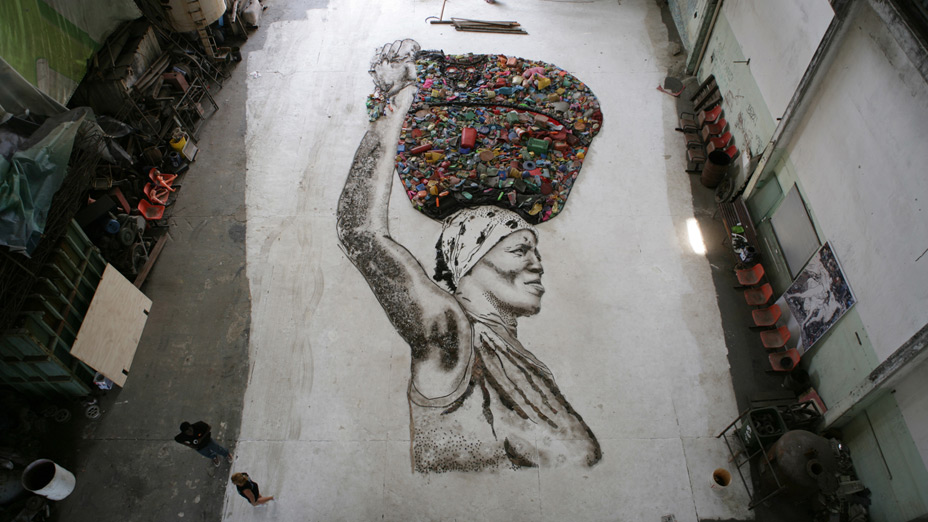
Vik Muniz (Brazilian) - social message focussing on raising awareness of different social groups
Finding beauty in a world of waste
Artist Vik Muniz explores the visible and the hidden in an unusual mix of materials
By DONALD EUBANK
Staff writer
"If we live in a creative universe, we are constantly pushing the chaos out of the way to protect ourselves from the nonlogical — the natural," muses Vik Muniz at an interview late last year at Tokyo Wonder Site. "Even when you think, you create waste. But everything is made in a way to conceal the waste.
The New York-based artist isn't afraid to step into that chaos. One of his latest projects, currently on show at Tokyo Wonder Site's Shibuya galleries, was realized in the biggest garbage dump in the world, Jardim Gramacho, north of Rio de Janeiro.
There, he worked with the people who scavenge the recyclable refuse of the city — catadores in Portuguese — to make a living. Muniz, who grew up in Brazil, works in unexpected mediums, taking photographs of drawings he does out of sugar, chocolate, dust. But he had always wanted to do something with trash.
"The beautiful thing about garbage is that it's negative; it's something that you don't use anymore; it's what you don't want to see," says Muniz in a movie made about the project with British documentary director Lucy Walker and Brazilian director Joa~o Jardim (tentatively titled "Extraordinary Garbage" or "The Art of Garbage"). "So, if you are a visual artist, it becomes a very interesting material to work with because it's the most nonvisual of materials. You are working with something that you usually try to hide."
The artist believes that the catadores too are invisible within the class system of Brazil. An estimated 3,000-5,000 people live in the dump, 15,000 derive their income from activities related to it, and some that Muniz met in Jardim Gramacho come from families that had been working there for three generations.
"These people are at the other end of consumer culture," he says. "I was expecting to see people who were beaten and broken, but they were survivors."
His aim — besides the creative challenge — was to see not only if the experience of creating art could change people, but, to answer the question, "can you change people; can this be done?"
Muniz selected a number of the catadores to collaborate with him to make their own portraits, including Irma~, a cook who sells food in the dump; Zumbi, the resident intellectual who has held onto every book he's scavenged; and 18-year-old Suelem, who first arrived there when she was 7. He rented 4 tons of junk and a warehouse, and together they arranged the trash on the ground to replicate photographs of themselves that Muniz had taken earlier. Then they would climb up to the ceiling and take photos of the compositions from 22 meters high.
The portraits of the people are made out of empty spaces, out of what wasn't garbage. Shown themselves in this light, the trash collectors were astonished. Two have since left the dumps; another, Tia~o, is using $64,097 from the project — money Muniz raised in an auction at Phillipe de Pury in London by selling the portrait he did of the politically active young catadore — for the Garbage Pickers Association of Jardim Gramacho.
"Ask them what they need, and they usually say 'nothing.' They live in a very civilized, honest way," observes Muniz. "People at the margins, including artists, we don't have power, but we have freedom."
Excerpt from: The Japan Times: Thursday, Jan. 1, 2009
Goya (Spanish) – war, inequality, class, religion
This image shows the random executions of the Spanish citizenry resulted from the fighting in the Puerto del Sol area of Madrid (Also see the Goya painting Second of May). A national uprising in Spain followed, and scenes such as Goya's 'Third of May' were repeated throughout the Spanish countryside, as the French commanders failed to quell the national mood, and instead made it more furious.
Goya had previously admired the practical freedoms the French "enlightenment" had promised. Most of the Spanish intellectuals of Goya's time were weary of the faltering efforts of Charles IV and Ferdinand to bring reform and improvement to Spain. However, the brutality of Napolean (through his brother Joseph & the military commanders instructed to minimize the fighting there) suspended whatever affection the Spanish liberals had for French freedoms.
For the length of the six-year occupation by the French, Goya lived almost entirely in Madrid. There is much speculation in art books about whether Goya personally witnessed events such as 'The Second of May,' and 'The Third of May." It is evident that Goya owned property at La Quinta, where the massacres took place, and there is (though disputed by some historians) a story by one of Goya's gardeners, a man named Isidro, who told Antonio Trueba (recorded in his book Madrid por fuera) that Goya witnessed the shootings at Montana del Principe Pio via telescope (a telescope was inventoried as belonging to Goya after his death), and that Isidro accompanied Goya later that night to the place where the corpses were, at which time Goya made notes. This account is referenced in Xavier de Salas book GOYA, published 1978 by Mayflower books.
...the Third of May, has become even more famous, haunting the covers of history books, appearing on postage stamps and postcards. It has been used to epitomize the art of Goya, as well as the spirit of Spanish revolutionary heroism. This violent yet moving image depicts the public execution of insurgents on 3 May 1808, the day following the insurrection [see Goya's Second of May] In contrast to the vigour of the street battle, in which the Spaniards appear, momentarily, to be gaining the upper hand, this massacre of civilians, which the French carried out in reprisal for the insurrection, has been painted in the most eye-catching colours. Here, in glowing whites, golds and scarlets against the sombre blacks, greys and browns of the background, the doomed men are immortalized, the street fighters from the Second of May meet their fate. One or two are recognizable: the corpse sprawled below the living victims, a prone male figure with matted blood-soaked hair and shattered skull, is identifiable as the hero with the dagger, stabbing the horse in the right-hand foreground of the proceeding picture.
[Above] from Sarah Symmon's book, Goya,
Phiadon Press, 1998. Page 263.
To read about Symmon's book, go here.
Also, visit Dr. Symmon's web site here.Most of the victims have faces. The killers do not. This is one of the most often-noted aspects of the Third of May, and rightly so: with this painting, the modern image of war as anonymous killing is born, and a long tradition of killing as ennobled spectacle comes to its overdue end.
[Above] from Robert Hughes book, Goya,
Knopf Books, 2003. Page 317.
To read about Hughes' book, go here.
Text from: http://eeweems.com/goya/3rd_of_may.html
Labels:
Cultural Framework,
male artists,
Romanticism
Subscribe to:
Posts (Atom)